Update 3/1/18: Moody adopted the Chicago Statement. I wrote a little follow-up here.
*****
I started the week like I always do, in prayer over Scripture for my church. I led our staff meeting, as well, in typical fashion, Bible open. It was open as we prayed Scripture over sensitive shepherding needs. It was open again for sermon prep, and it went with me to a lunch with a new friend from the community. Moody’s middle name is Bible, and the Lord used Moody to put the Bible in the middle of my life and shepherding. I am ever grateful and you should be encouraged.
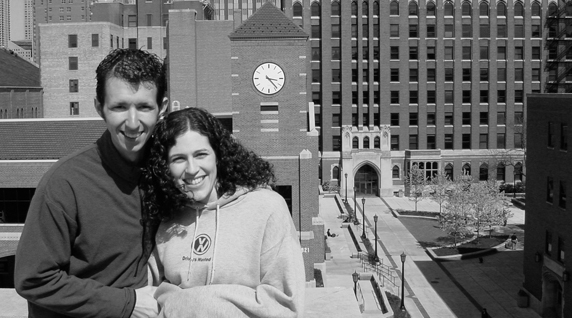
He used Moody to put the Bible in the middle of my family as well. I met my wife there. I noticed her on the first day of our first class, and we were married the summer following graduation in ’03. Our first date was over flashcards for a Greek exam. We walked the streets of Chicago and the halls of Sweeting, and we loved every minute of it. We still pop in when we’re in town.
That was fifteen years ago now. Since ’03 we’ve served in St. Louis, Louisville, Albuquerque, and now Greenville, SC. Moody was not well known in these places, but we were glad to make the introduction and point people your way.
But for now those introductions are on hold. Hopefully just for a bit. They are not on hold because we know that allegations of theological drift are true. They are on hold because the claims are serious, the souls under my care are precious, and I am not sufficiently convinced that they aren’t true. That’s hard to say to the school and to people I love. There’s so much I don’t know. But this may be the unstated posture of many graduates like me.
What am I supposed to say?
What am I supposed to say when a member at my church asks me if Moody still holds to the inerrancy of Scripture? Should they give? Should they send their student? What am I supposed to say when they ask about these related stories of subversive teaching on Adam, a professor whom they heard supports planned parenthood, and the denial of a correspondence theory of truth among some faculty? What about the alleged hiring of an egalitarian who was herself an ordained pastor, and layoffs that may be part of a plan to silence those who registered their concerns? Given my responsibility as an undershepherd before Christ, as one charged to “follow the pattern of sound words†handed down, what am I supposed to say (2 Tim. 1:13)?
I could tell them that Moody has assured us that everything is alright. But that’s not “guard[ing] the good deposit†entrusted to me (2 Tim. 1:14). People can swerve from the truth, and as history shows, so can institutions (2 Tim. 2:18). Taking your word for it turns the old motto, “the name you can trust†into “just trust us.†You taught me better than that and I’m grateful.
These things may well be untrue or twisted. I did learn them on the internet. I know very little about Julie Roys. Her name only came to me in the context of her reporting on Moody. What I know I know from what she has published, Moody’s response, and a few other articles. Who is right? Thankfully, I don’t need to know in order to do my work as a pastor. But I do need to know if I’m going to trust Moody with the training and shaping and giving of those under my care. There are other schools.
Call me crazy, but I see a great opportunity here.
Moody, the next move has to be as clear as the last few months have been confusing for all of us. Moody, take this chance to not only put my reservations at ease, but to convert this confidence-crumbling moment to a confidence-doubling moment. We entrust ourselves to a God who indeed brings great wonders from great trouble. He does it in people, he does it in churches, and he has done it in institutions like Moody.
What will that take?
First, I pray that MBI will settle the inerrancy question. Please don’t merely deny Julie’s allegations. Demonstrate that her allegations are untrue in concrete terms. Or, repent of what truth there is in those allegations with concrete steps to secure our trust. Whatever the case, requiring adherence to the Chicago Statement on Biblical Inerrancy would not only put me at ease, but excite me for Moody. In specific terms, that would answer the question of what Moody Bible Institute means when they say, “Bible.†There are other ways to do that, but this is one. I recognize how difficult it is to sort these things out in public. You’re in an unenviable position. But nonetheless, eternity—eternal life—is staked upon the truth, and there is no truth if the Bible is not wholly authoritative.
Second, I pray, as well, that you will reflect this Bible seriousness in your appointment of the next President. Beyond being an institutional leader, he needs to be a courageous, tested, and defined theological leader. He has to have more than a vision for Moody, but convictions rooted enough and clear enough to ground and guide a place like Moody in times like these. Even better, appoint a known and trusted commodity like what Dr. Ryken was to Wheaton’s transition a few years ago. This too would more than reassure me, but excite me.
There’s more that could be said. But I’ve focused on the first and essential matter: the Scriptures. After all, Paul delivered that which was of first importance, the death and resurrection of Jesus, “in accordance with the Scriptures†(1 Cor. 15:3-4).
Here’s what I’d like to say a year from now. “Moody had a rough year, but she’s better for it; stronger to strengthen the church for her work in the world. I commend her to you. Check it out and go.â€
Moody has our attention for all the wrong reasons. But now that you have it, do something compelling and courageous. I’m eager and even excited for what’s next at 820 North LaSalle. May God bless the school that D.L. Moody founded on the Word of God.
That’s how I’m praying, and I’m optimistic.
Your proud alum,
Trent Hunter
Pastor for Preaching and Teaching, Heritage Bible Church, Greer, SC
Student Council President, ‘01–‘03